
Governance · October 14, 2026
The Floor of Defensible AI: Reaching Governed and Moving Beyond
By David Monahan · Data Defenders, LLC · Three traps between you and Governed AI — and how to clear them
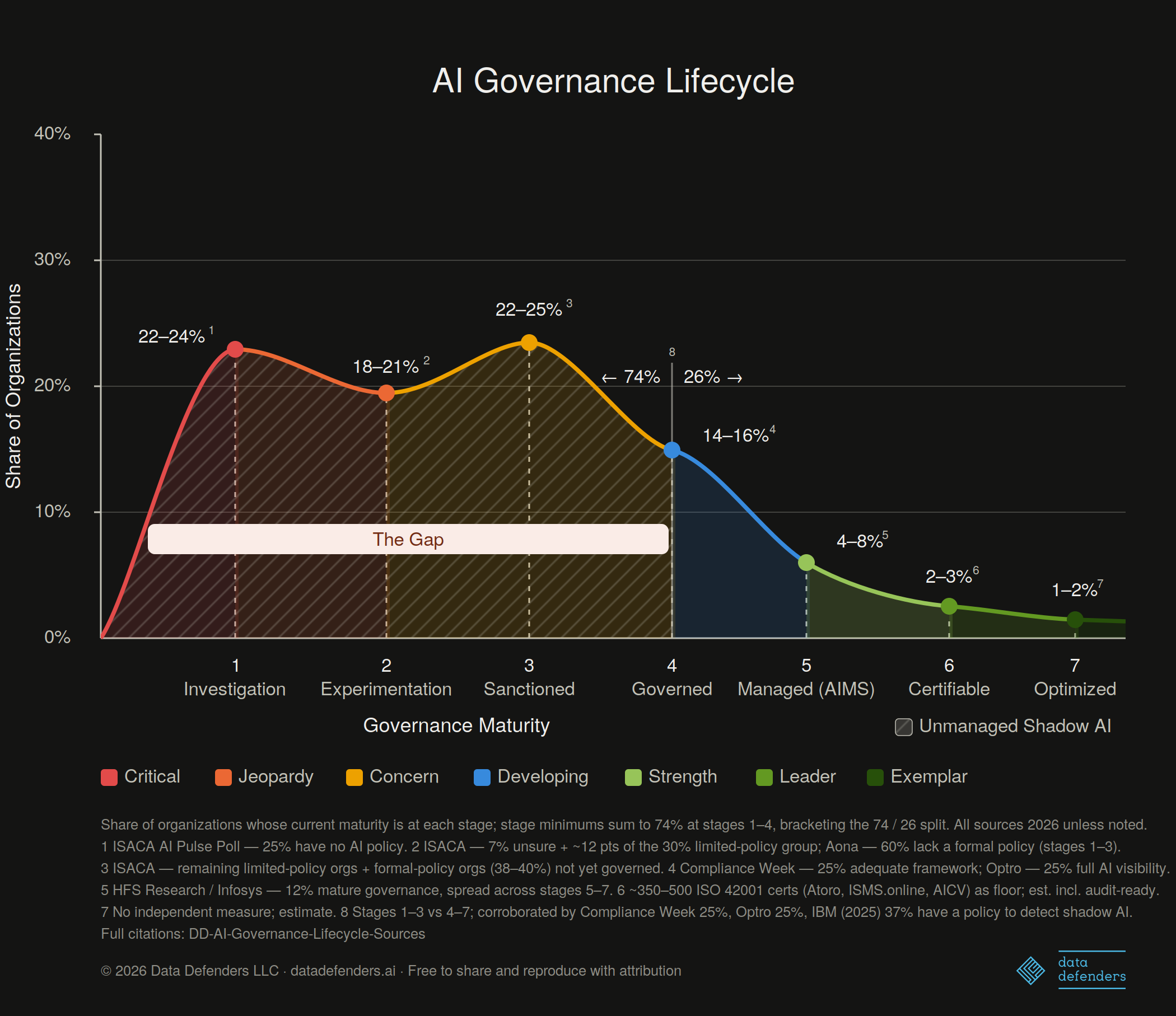
The last two posts in this series mapped where organizations are stuck — three-quarters of them in the first three stages of the AI Governance Lifecycle — and what that costs. This one is about the first stage that moves an organization out of the trap. Governed is the floor of defensible AI: the first stage a regulator, auditor, cyber carrier, or plaintiff's lawyer treats as managed. Reaching it isn't the finish line, but it is the real starting line.
What's new in 2026 is that the research on both ends of the question is specific — what mature programs do, and what keeps the rest stuck. Both are short lists.
The three components of a Governed program
Achieving the transition takes effort. There are three top operational elements lacking in the Sanctioned stage. Credo AI's 2026 survey of 371 governance leaders identified the same three traits that separate mature programs from stuck ones: a maintained AI inventory that's actually used, named accountability across business lines, and formal review workflows that gate deployment. Programs missing any one of them scored lower on every readiness indicator the survey measured.
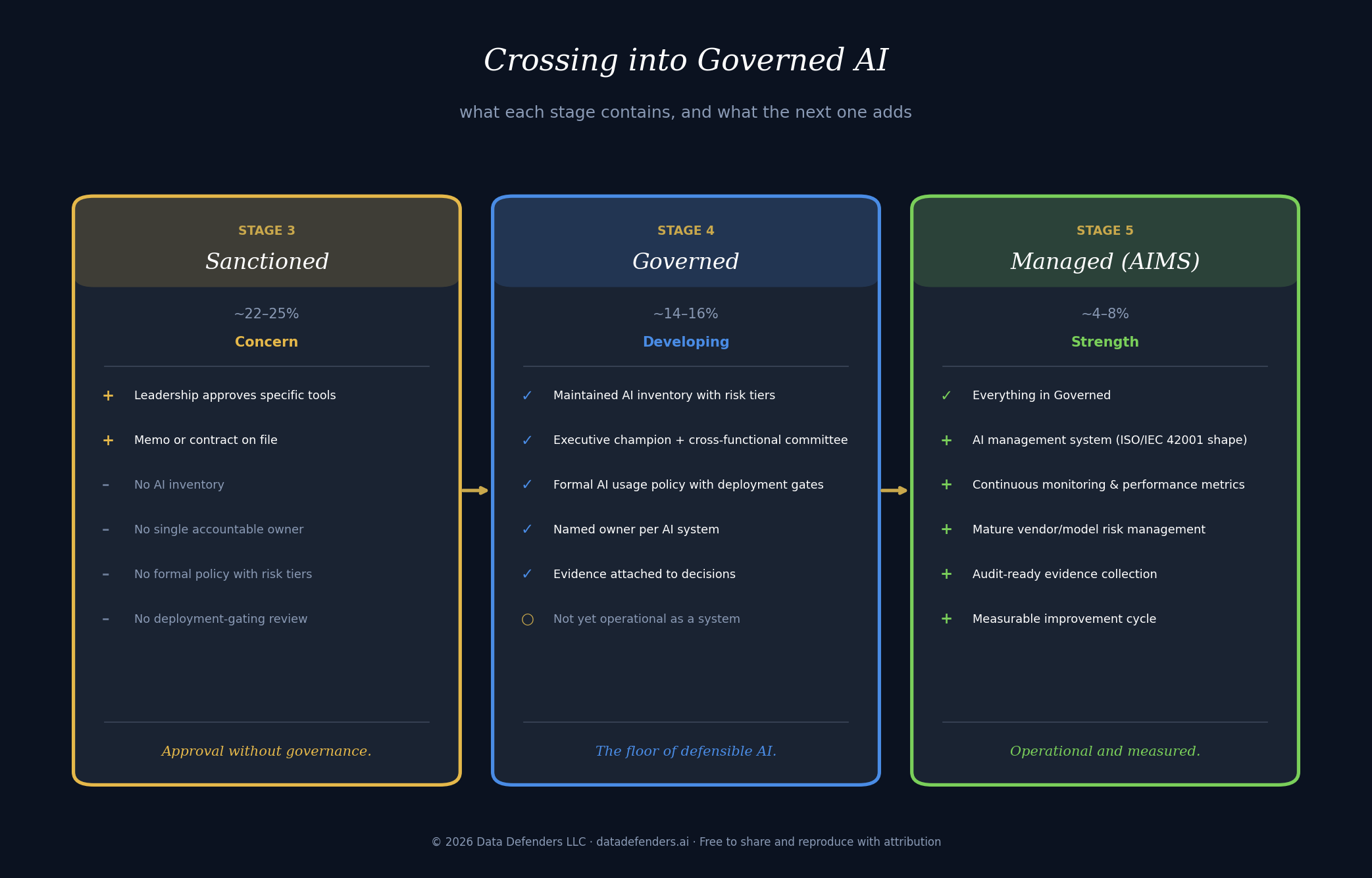
The three objectives below are those three traits translated into actions. Each one is paired with the trap that most commonly keeps organizations out of Governed — not theoretical traps, but the specific failure modes the 2026 research keeps surfacing.
1. Build a maintained AI inventory with risk tiers
Every AI regulation starts with the same assumption: that the organization knows what AI it has. NIST AI RMF, ISO/IEC 42001, the EU AI Act, and the Colorado AI Act all require some form of inventory, and all of them assume a risk classification sits on top of it. Continuum GRC's 2026 AI Governance Benchmark found that 63% of organizations have an AI inventory of some form, which sounds encouraging until you look at the next number: 59% of the listed AI systems in those inventories had no formal risk classification at the last review. The inventory exists; the triage that would make it useful does not.
The inventory a Governed organization keeps covers more than the obvious. It includes the sanctioned enterprise tools, the pilots and proofs of concept, the AI features vendors have embedded into existing software, and the shadow uses detected through monitoring. Each entry has a named business owner, a declared use case, a data classification, and a risk tier — commonly low, medium, or high — that drives everything downstream.
Pitfall: treating the inventory as a one-time catalog, or skipping it entirely to "start with policy." Both failure modes have the same root — an inventory feels like paperwork. In practice, a static inventory lies within weeks because adoption races ahead of documentation. And a policy written before the inventory describes assumptions, not the organization's actual exposure. The sequence matters: inventory first, policy second.
2. Appoint an executive champion backed by a cross-functional committee
Governance is an accountability problem before it is a technology problem. Deloitte's 2026 State of AI in the Enterprise, surveying over 3,000 organizations, found that only 21% have a mature AI governance framework, and that 84% have not adjusted job descriptions to reflect AI responsibilities. Beena Ammanath of Deloitte summarized the pattern as "accountability usually breaks down first." Gartner's Lauren Kornutick called the current state "a multi-role orchestration problem," with governance spread across CIOs, data and analytics leads, AI leads, IT security, and Legal. Forrester reports that only 21% of organizations have appointed a Chief AI Officer, and that 24% expect to move AI governance outside the CIO's office entirely within the next year to address the fragmentation.
The structure that works in practice has two parts. An executive champion — a CISO, CTO, Chief AI Officer, or equivalent — owns outcomes and has authority to make binding decisions, including stopping an initiative. A cross-functional governance committee brings Legal, Risk, IT Security, HR, and business-unit leads into the operational cadence; the committee informs and executes, the champion decides.
Pitfall: scattered tool ownership — nobody owns the program. This is the common reality today. IT owns ChatGPT Enterprise. HR owns the applicant-screening platform. Marketing owns Copilot. Legal owns the vendor contracts. Each team has made reasonable local decisions. No one has end-to-end accountability for what the organization is doing with AI, which means no one can answer the regulator's first question — "who is responsible for your AI program?" — with a name. Rajesh Arora of Principal Financial Group put it directly: "Most organizations can acquire governance tools, but far fewer have clear ownership and decision rights."
Not sure which stage your organization is in?
Pick the framework that fits your situation and take a free 15-question snapshot. On-screen results with no signup, or choose the optional PDF to take away.
See the snapshots →3. Write a formal AI usage policy with risk tiers and deployment-gating review
Policy is where ownership and inventory become operational. Continuum GRC's benchmark found that 71% of organizations have an approved AI use policy — a reasonable number on its face — but that 71% of those organizations use the policy as their only governance posture, with no framework alignment behind it. A policy without a framework is a document; a policy anchored to a framework is a program. Credo AI's third mature-program trait is formal review workflows that gate deployment, which is where a policy stops being a document and starts being enforcement.
A Governed policy defines what use cases are allowed, what data types are permitted at each risk tier, what controls are required before deployment, and who approves what. The risk tier from the inventory drives the policy; the policy drives the review workflow; the review workflow produces the evidence a regulator or auditor eventually asks for.
Pitfall: buying governance tools before writing the policy. Tools automate decisions you have already made. They do not substitute for the decisions themselves. A Shadow AI detection platform, a model risk dashboard, or a procurement bolt-on will enforce whatever rules are in it; if those rules are missing, the tool enforces nothing. Automation without a firm direction will carry an organization the wrong way as fast as a correct foundation will accelerate good outcomes. The sequence that works is inventory, then champion and committee, then policy with gating, then tooling that automates what the policy already says.
What comes after Governed
Governed is the floor, not the ceiling. The Managed stage — Strength severity band — is where the Governed foundation becomes an operational AI Management System, or AIMS, in the shape ISO/IEC 42001 describes: continuous monitoring, performance metrics, mature vendor and model risk management, and audit-ready evidence collection. Certifiable — the Leader band — is where the organization could pass an ISO/IEC 42001 audit today, whether or not it has pursued the certificate; with fewer than 500 certificates worldwide, demonstrable certifiability is itself a differentiator. Optimized — the Exemplar band — is where measurable improvement cycles run against the AIMS. Each stage after Governed adds measurement, not more documentation.
How Data Defenders moves organizations across the line
Our platform is built to shorten the time between where an organization is today and where Governed sits. The free AI Maturity Snapshot gives a directional read in 15 questions — which stage, which severity band, which objectives are missing — mapped to the framework that fits the organization's situation (NIST AI RMF, ISO/IEC 42001, EU AI Act, or Colorado AI Act). The full AI Maturity Assessments pick up where the snapshot stops: control-level findings anchored to the underlying standard, each carrying a remediation recommendation tied to benchmark research. The output is a prioritized path to Governed, and every finding is mapped to the ISO/IEC 42001 certification bar — so an organization can see what closes the distance before it spends money on a registrar.
The takeaway
Three objectives cross the line: a maintained inventory with risk tiers, an executive champion backed by a cross-functional committee, and a formal policy with deployment-gating review. Three traps keep organizations from reaching 'Governed': skipping or neglecting the inventory, scattering ownership across teams, and buying tools before writing the rules. Governed is where defensibility begins; everything stronger builds on it. The organizations crossing the line in 2026 will be the ones a regulator, auditor, carrier, or plaintiff treats as managed.
Next in the series: how AI risk is actually assessed and quantified — the methods, the framework alignment, and what good risk scoring looks like.
Related
Find out which stage you're actually in. Take one of our free AI Maturity Snapshots — 15 questions, no signup.
The free snapshot is directional. If you are concerned with your results and need a defensible, control-level view with remediation guidance mapped to a recognized framework, that's what our full AI Maturity Assessments are built for.
See the snapshots →Sources: Credo AI survey of 371 governance leaders (2026); Deloitte State of AI in the Enterprise (2026, 3,235 organizations); Deloitte via Beena Ammanath on accountability as the first break-point; Gartner via Lauren Kornutick on multi-role orchestration; Forrester via Craig Le Clair on Chief AI Officer appointment rates (21%) and governance relocation projections (24%); Continuum GRC 2026 AI Governance Benchmark Report (63% have inventory, 59% lack risk classification, 71% have approved AI use policy, 71% of policy-holders use it as sole governance posture); Rajesh Arora, Principal Financial Group, on ownership versus tooling; NIST AI RMF (GOVERN function); ISO/IEC 42001:2023 AI Management System; EU AI Act (Regulation 2024/1689); Colorado AI Act (SB24-205, SB26-189); ISO/IEC 42001 certificate trackers (Atoro, ISMS.online, AI Compliance Vendors).
Talk to Us Directly
Free 25-minute consultation. Bring your questions.